
Single-Use vs. Reusable Suction Devices: What the Evidence Says
Cleaning failure rates, intraoperative contamination and infection cost, with the source for each claim.
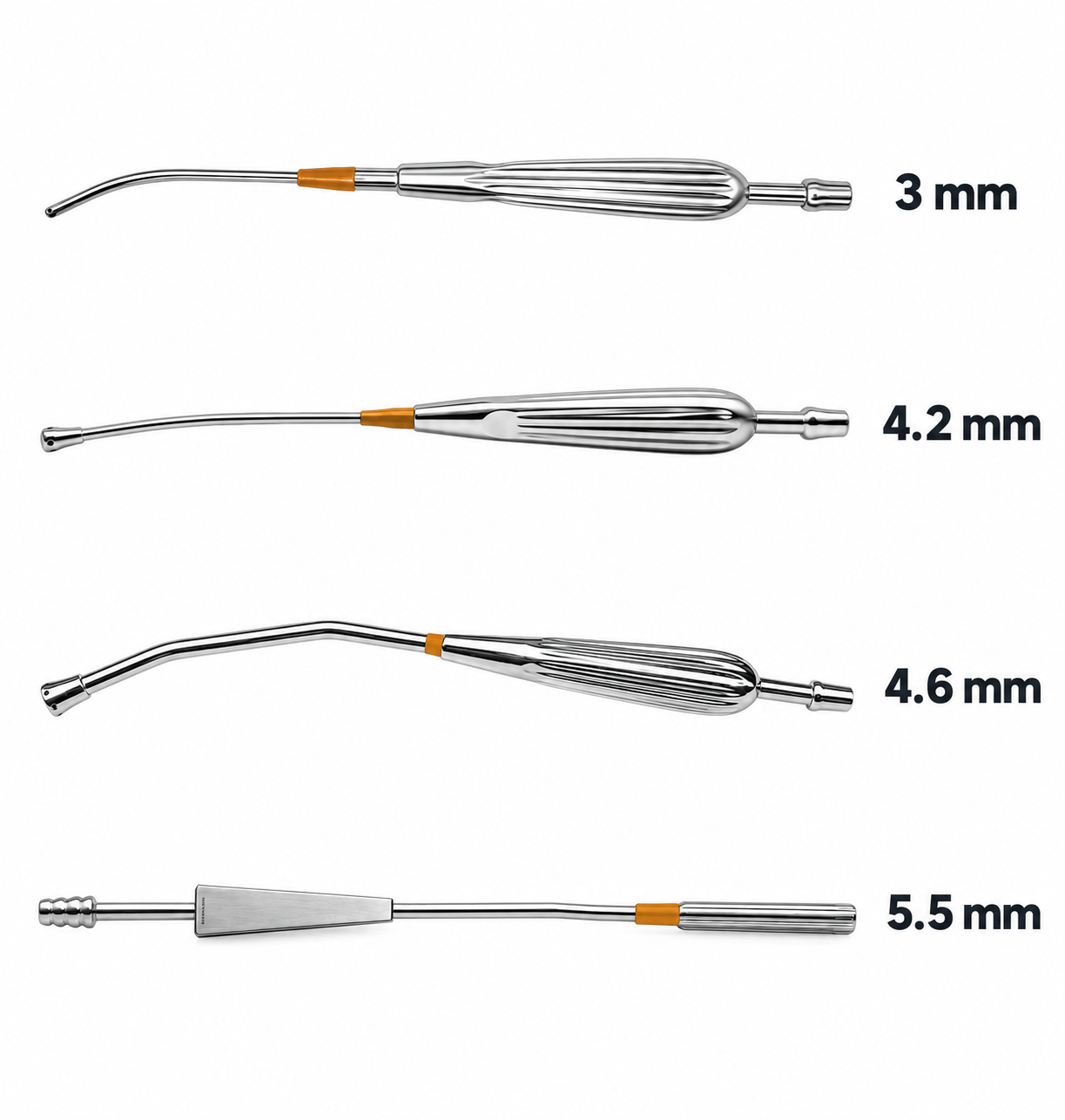
Reusable suction devices fail cleaning inspection far more often than most teams expect, and suction tips pick up bacteria during the case itself. Single-use suction devices remove both problems by starting every procedure with a new sterile instrument. This page compares the two on the points that matter to infection prevention, sterile processing and procurement.
Side by side
| Factor | Reusable suction device | Single-use suction device |
|---|---|---|
| Cleaning outcome | 39.5% of 190 suction-type lumen instruments failed ATP testing after reprocessing (Wu & Li, Scientific Reports, 2025) | No reprocessing; instrument is new and sterile at every case |
| Residual debris in lumens | Debris or discoloration in 100% of 40 lumened instruments, persisting after recleaning (Ofstead et al., AJIC, 2025) | Not applicable |
| Inspection | Visual inspection with a 5x magnifier passed 94.2%, ATP passed only 60.5% of the same instruments (Wu & Li 2025) | No lumen inspection required |
| Intraoperative contamination | Bacteria on one or both suction tips in 80% of 25 aortic valve replacements (Larsson et al., Patient Safety in Surgery, 2015) | Same exposure during the case; can be swapped for a new sterile tip at critical steps at low cost |
| Cost per case | Purchase price spread over uses, plus labor, chemicals, inspection and replacement of damaged units | One fixed line item per case |
| Cost of a surgical site infection | $20,785 per case (Zimlichman et al., JAMA Internal Medicine, 2013) | Same |
| Traceability | Depends on tray tracking | Lot number on every unit |
Why lumened instruments are the hard case
A suction cannula is a long, narrow tube. Brushes do not reach every surface, soil dries inside within minutes, and the inside cannot be seen without a borescope. Wu & Li found that a delay of 20 minutes or more between use and cleaning, heavy soiling, short pre-soak and manual cleaning all lowered pass rates. Ofstead's team found lint and brush bristle fragments inside 73% of the lumens they inspected. The cleaning process itself was leaving material behind.
Contamination during surgery
Larsson and colleagues cultured 50 suction catheter tips from 25 aortic valve replacements. Contamination was found in 52% of first-half tips and 48% of second-half tips; coagulase-negative staphylococci were the most common organisms. Their recommendation was to exchange the suction catheter before valve implantation and sternal closure, noting the exchange is quick and inexpensive compared with treating mediastinitis. That recommendation is only practical when the replacement tip is single-use and sterile.
What this means for your program
If your cardiac trays still carry reusable suction cannulas, they are the instruments most likely to fail inspection and the least likely to be inspected in a way that catches it. Moving suction to single-use is one of the smaller changes a sterile processing department can make, and it removes an entire class of lumened instrument from the reprocessing load.
Sources
Wu & Li, Scientific Reports, 2025 · Ofstead et al., AJIC, 2025 · Larsson et al., Patient Safety in Surgery, 2015 · Zimlichman et al., JAMA Internal Medicine, 2013
See the single-use line
HNM Medical makes sterile, single-use cardiac suction cannulas in 3 mm, 4.2 mm, 4.6 mm and 5.5 mm tips.
Request samples for your OR
Send us your procedure mix and we will reply with pricing and samples for your team to evaluate.
Request a quoteRequest samples